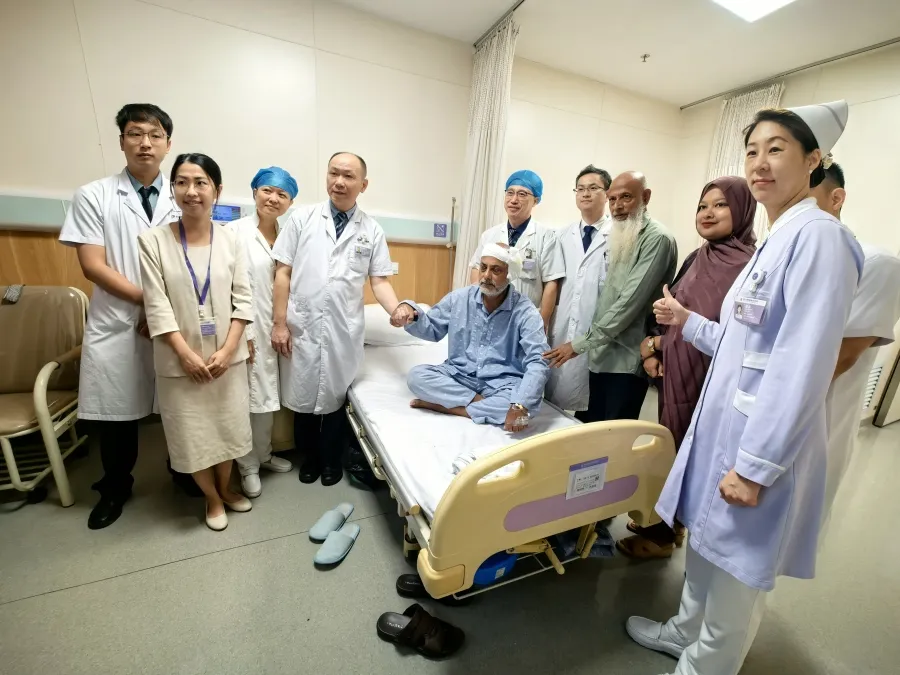
On the morning of August 27, 2026, the ward at Foshan Chancheng Hospital felt more like a family farewell than a hospital discharge. Specialists from Otolaryngology, Vascular Surgery and Neurosurgery gathered around Mr. Zakir, a patient from Bangladesh, to review his recovery, give rehabilitation advice and take a photo before his journey home.
Three weeks earlier, the same team had spent nearly 20 hours in the operating room, successfully removing an aggressive glomus jugulare tumor that reached from the skull base into the temporal bone and upper neck. The entire procedure was completed without a blood transfusion.
“Thank you, China.”
From Dhaka to Foshan: Choosing Expertise Over Uncertainty
Mr. Zakir’s journey began a year earlier in Bangladesh, where doctors diagnosed a left-sided glomus jugulare tumor. The tumor was highly vascular and locally invasive, with the potential to extend toward the skull base and upper cervical spine. Local surgeons told him the operation would be difficult to manage at home and recommended seeking care abroad.
At first, Mr. Zakir and his family looked at Thailand, Singapore and India. “They said they would examine me first and then decide what to do,” he recalled. The uncertainty made him hesitate.
He then learned that Foshan Chancheng Hospital had an experienced skull-base and otolaryngology team. After several rounds of remote communication, his confidence grew. “They told me there were experienced doctors here and that this type of surgery could be performed,” he said. Despite never having been to China, he decided to travel to Foshan.
Why the Tumor Was So Challenging
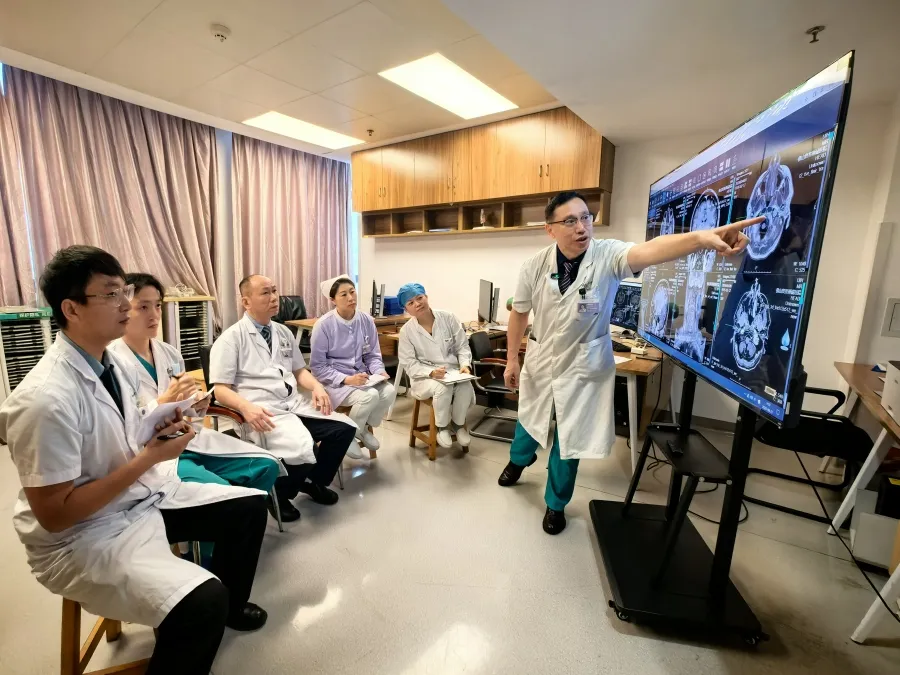
Glomus jugulare tumors arise near the jugular foramen, deep in the ear and skull base. They are among the most technically demanding tumors in otolaryngology because they sit close to the internal carotid artery, facial nerve, auditory nerve and lower cranial nerves.
Mr. Zakir’s tumor was especially extensive. It involved the skull base, temporal bone and upper neck and had already reached the dura mater, the protective membrane around the brain.
“The greatest challenge was the tumor’s rich blood supply and invasive nature,” explained Dr. Mei Xiaofeng, Director of Otolaryngology at Foshan Chancheng Hospital. “One small mistake could cause massive bleeding, facial paralysis, hearing loss or even a life-threatening event.”
A Four-Stage, Multidisciplinary Operation
Because the case crossed anatomical regions and surgical specialties, the hospital convened an MDT involving Otolaryngology, Vascular Surgery, Neurosurgery, Radiology and Anesthesiology. The team mapped out the operation in four stages:
Surgical strategy
- Protection — identify and shield the carotid artery, facial nerve, auditory nerve and lower cranial nerves.
- Dissection — carefully separate the tumor from healthy tissue.
- Resection — perform total temporal bone resection to remove the tumor completely.
- Reconstruction — repair the dura mater and reconstruct the surgical defect.
At 10:00 a.m. on August 6, the operation began. Four senior chief physicians led the procedure: Dr. Mei Xiaofeng (Otolaryngology), Dr. Du Guoneng (Vascular Surgery), Dr. Chen Baozhong (Neurosurgery) and Dr. Zheng Ligang (Otolaryngology).
By 5:00 a.m. on August 7, nearly 20 hours later, the surgery was complete. Through meticulous dissection and precise hemostasis, the team kept blood loss so low that no transfusion was needed.
Recovery and a Vote of Confidence
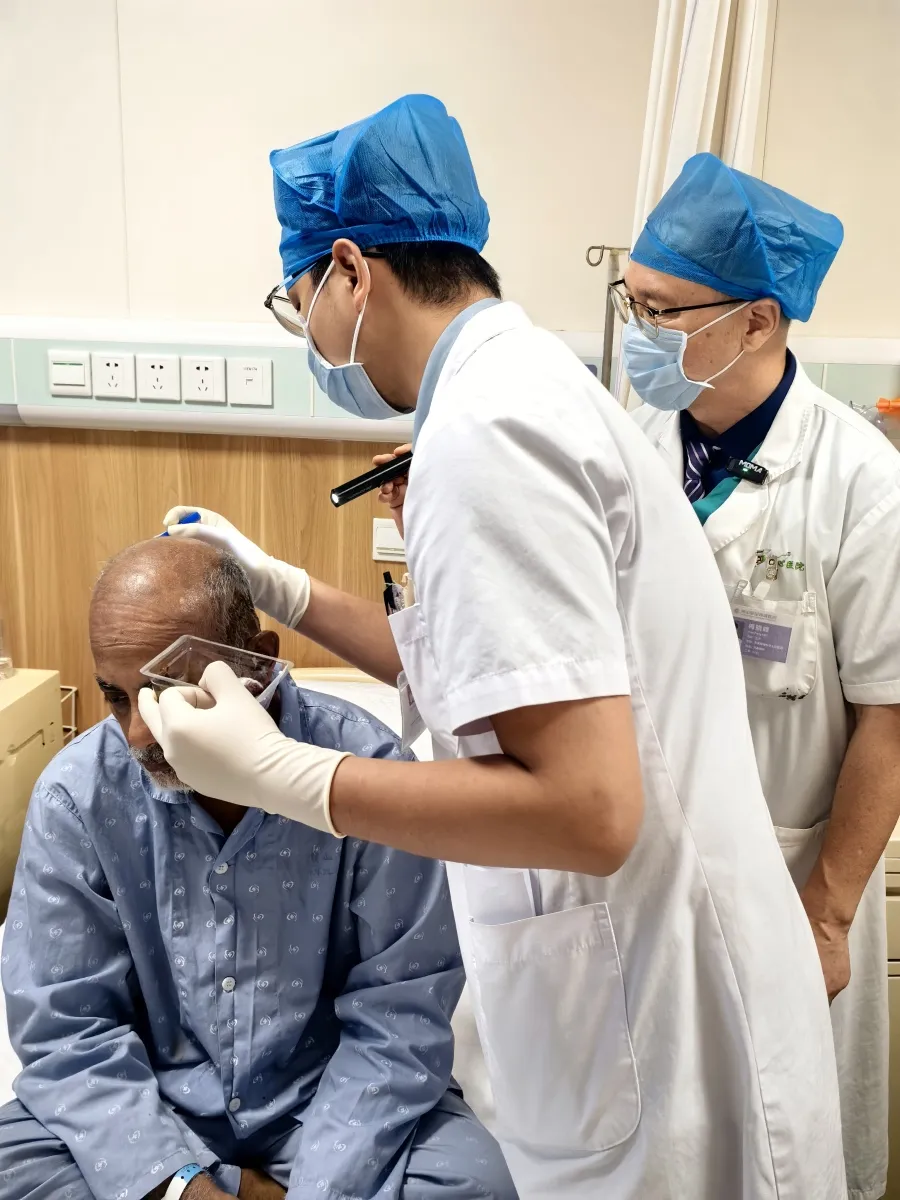
Three weeks after surgery, Mr. Zakir was recovering well. His hearing remained at preoperative levels, the mild facial weakness he had experienced before surgery had fully resolved, and his headaches were gone.
“China has very good medical technology and very experienced doctors,” he said. “The doctors and nurses were careful, responsible and kind. Every step made me feel safe.”
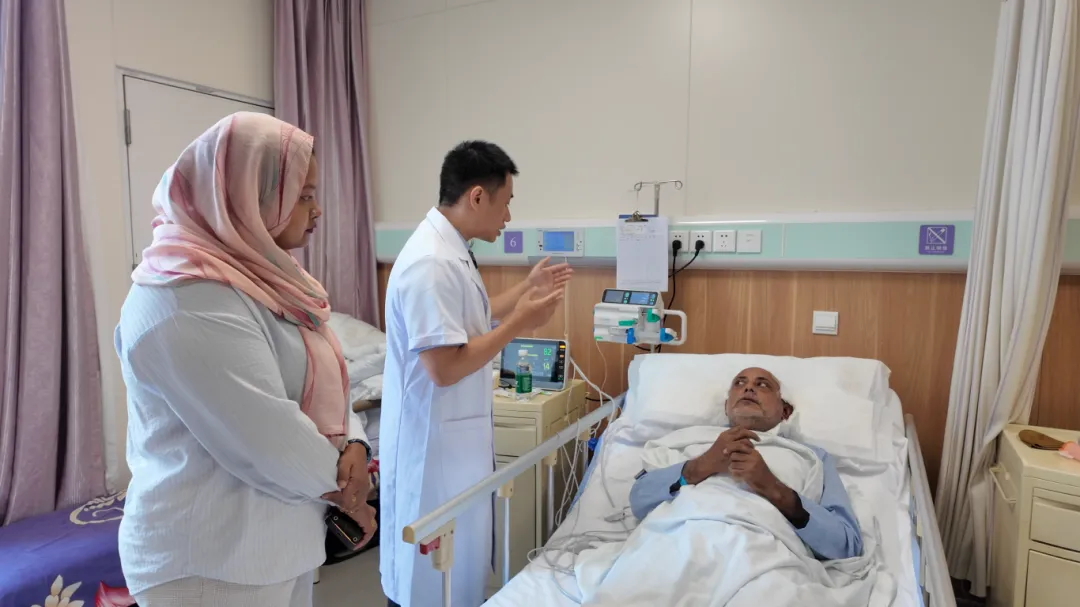
Cases like Mr. Zakir’s reflect a broader shift: as China’s medical capabilities advance, more international patients are choosing the country for complex procedures. For Mr. Zakir, the decision to travel from Bangladesh to Foshan was not only a choice of hospital—it was a vote of confidence in Chinese medical expertise.