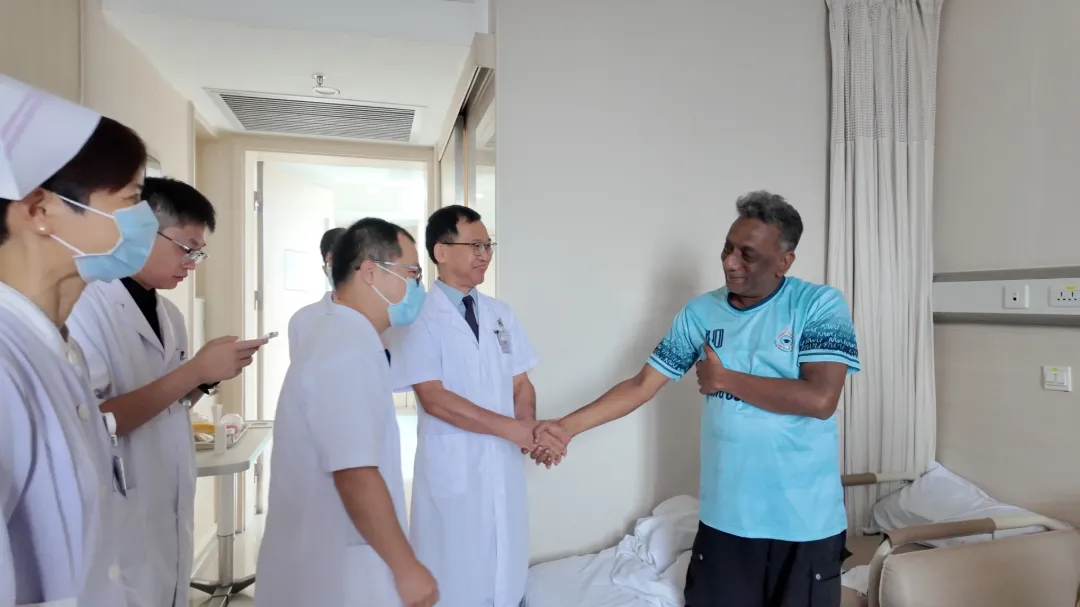
At 20, most young women are planning their futures. For Tina (pseudonym), a patient from Bangladesh, the past two decades had been shaped by a rare genetic condition. When persistent waist and abdominal pain appeared over three weeks, imaging revealed a tumor larger than 7 cm in her left kidney — positioned dangerously close to the main renal artery, with abundant surrounding collateral vessels.
Tina and her family had sought help in several countries. The answer was nearly always the same: the operation would be extremely difficult and the risk hard to control. As anxiety mounted, they turned their attention to China. Through a local medical-service agency, they learned about Foshan Chancheng Hospital International Medical Center (FIMC).
What Is Tuberous Sclerosis Complex (TSC)?
Tuberous sclerosis complex (TSC) is a rare, heritable disorder that can affect multiple organ systems. The kidneys are commonly involved, and TSC-associated renal angiomyolipoma (TSC-AML) is one of its important renal manifestations.
Although renal angiomyolipomas are often benign, "benign" does not mean "can be ignored." TSC-AML tends to appear earlier, may be multiple or bilateral, and contains richly abnormal vessels. As the mass grows, the risk of spontaneous bleeding rises. For a young patient like Tina, preserving kidney function was essential to lifelong quality of life.
Why Not Simple Embolization?
For some TSC-AML patients, transarterial embolization is an option. In Tina’s case, however, the lesion’s rich collateral blood supply meant embolization might not fully cut off the tumor’s nutrition. The mass might not shrink completely, requiring close follow-up or even a second procedure. Moreover, complete surgical removal would provide a definitive pathological diagnosis.
The urology team at Foshan Chancheng Hospital therefore set a clear goal: remove the tumor while preserving the affected kidney as much as possible. Achieving this meant performing a partial nephrectomy — a procedure that temporarily clamps the renal artery, then removes the tumor and reconstructs the kidney within a narrow window of "warm ischemia." The shorter that window, the better the kidney is protected.
Challenge of the case
- Tumor >7 cm, pressing against the main renal artery
- Abundant collateral vessels around the lesion
- Any imprecise dissection or suturing could cause major bleeding
- Risk of conversion to total nephrectomy if control was lost
Da Vinci Robot: Precision at the Millimeter Level
After detailed preoperative evaluation, the urology team chose Da Vinci robot-assisted partial nephrectomy. The Da Vinci system is not autonomous: the surgeon sits at a console and controls robotic arms that extend the surgeon’s hands inside the body.
- Clearer vision: 3D high-definition magnification helps the surgeon identify tumor margins, renal vessels and surrounding anatomy.
- Greater flexibility: the robotic wrists move with more degrees of freedom than a human hand, enabling precise dissection and suturing in tight spaces.
- Steadier motion: the system filters natural hand tremor, making every movement more stable.
With Da Vinci assistance, the team successfully removed two tumor lesions and kept Tina’s left kidney fully intact.
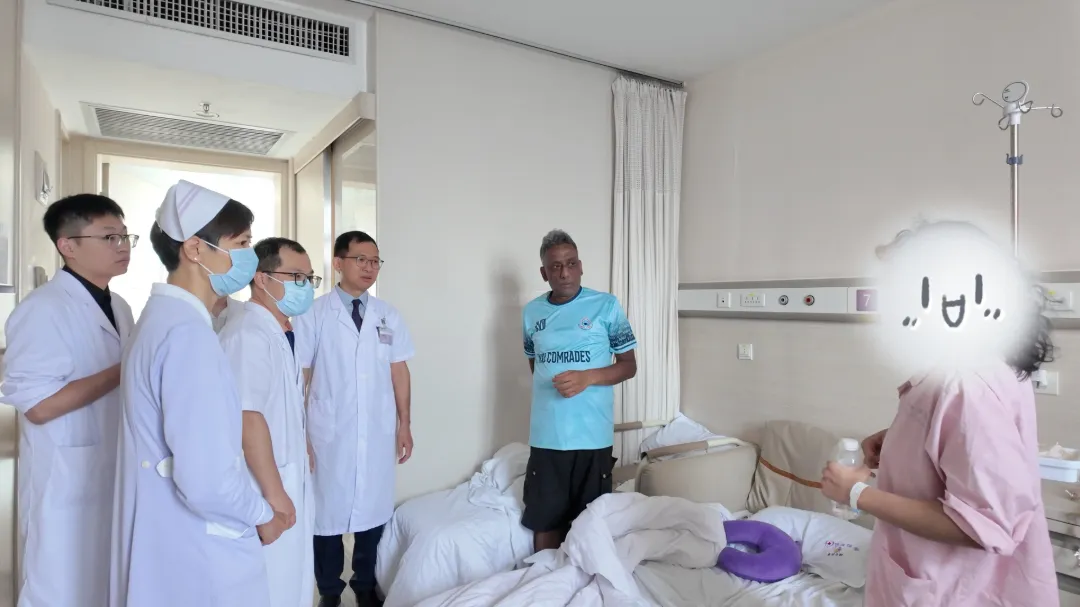
"Thank You for Giving Me a Second Life"
On discharge day, Tina and her family thanked the care team. "From Dhaka to Foshan — 2,800 kilometers — thank you to every doctor and nurse for giving me a second life," she said.
Her father added, "The surgery was very successful. The doctors and nurses treated us like family. Someone checked on her recovery every day." During the mother’s stay as a caregiver, she also felt unwell; FIMC arranged prompt examinations and care. The hospital also coordinated culturally appropriate meals, helping the family feel at home far from Bangladesh.
"For a young TSC patient, preserving one kidney means preserving a lifetime of quality of life."
End-to-End International Patient Support
Tina’s story illustrates how FIMC supports overseas patients at every stage: pre-visit online consultation and visa assistance, multilingual accompaniment after arrival, daily-life coordination, customized treatment planning during care, and rehabilitation guidance after discharge.
Foshan Chancheng Hospital continues to combine international-standard technology with human-centered care — protecting every patient’s health and future.