
Foshan Chancheng Hospital recently held the "HK-Macao Drug & Equipment Connect" dual-effect orbital atherectomy symposium and completed the first clinical application in mainland China of the Diamondback 360 coronary orbital atherectomy system.
Academician Ge Junbo, Director of Cardiology at Zhongshan Hospital, Fudan University; Professor Chen Jiyan from Guangdong Provincial People's Hospital; and Professor Tam Koon Cheong from Kiang Wu Hospital in Macao joined the symposium and the procedure. The milestone means that residents of the Greater Bay Area can now access globally advanced medical technology "at their doorstep," with more new options for diagnosis and treatment.
An Efficient New Solution for Severely Calcified Lesions
Coronary heart disease is one of the leading threats to health in China, with incidence rising steadily. Percutaneous coronary intervention (PCI) is a key weapon against it — but severe coronary calcification is the core challenge of interventional treatment. It makes vessels hard and inelastic, and often prevents devices from passing through or balloons from dilating fully. It is the most common "roadblock" interventional cardiologists face.
To tackle this clinical problem, the innovative dual-effect orbital atherectomy system entered mainland China for the first time through the "HK-Macao Drug & Equipment Connect" policy channel — landing in Foshan, Guangdong.
Mr. Guo, 51, had long suffered from coronary heart disease. Two months earlier he was rushed to hospital with sudden chest pain, shortness of breath that worsened on exertion. Coronary angiography showed severe disease in all three major vessels: diffuse, severely calcified stenosis of the mid-proximal left anterior descending artery, near-total occlusion of the circumflex, and a patent but heavily calcified right coronary artery. His case was further complicated by hypertension, diabetes and a history of cerebral infarction — and the heavy calcification meant interventional devices could hardly pass through the narrowed vessels. After evaluation by the cardiology team, the calcified vessels first had to be "unlocked" to raise the success rate and reduce procedural complications. Leveraging the "HK-Macao Drug & Equipment Connect" policy, Foshan Chancheng Hospital introduced the Diamondback 360 system; after multidisciplinary discussion and the patient's consent, the team proceeded with the innovative technique.
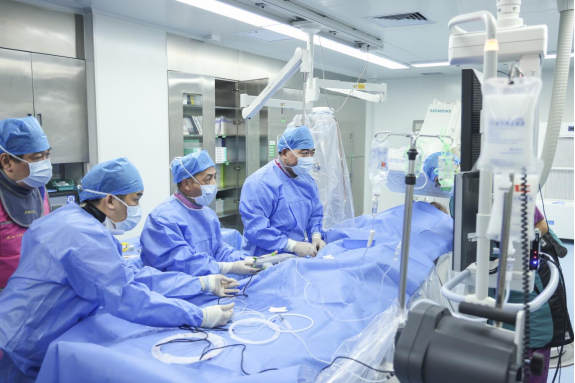
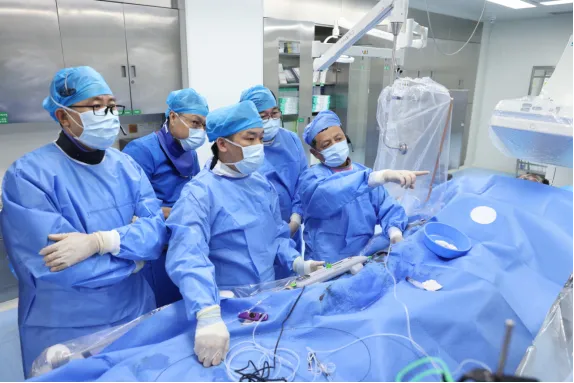
During the procedure, doctors advanced the 1.25 mm burr into the calcified vessel, where high-speed rotation precisely ablated the calcified plaque — successfully clearing the "stubborn stones" blocking the vessel. The team then implanted stents smoothly, restoring blood flow, and the patient's flow recovered well after surgery.
One Device, Dual Effects — Handling Calcification with Ease
Academician Ge Junbo, Director of Cardiology at Zhongshan Hospital, Fudan University, said: "For interventional cardiologists, 'fear nothing in heaven or on earth — but fear a calcified coronary.' Calcified lesions pose a major challenge to PCI, and conventional techniques have limitations against complex, severe calcification, affecting success rates and patient outcomes. The arrival of dual-effect orbital atherectomy gives us a new solution: it handles complex severe calcification better and brings patients more precise, safer and more effective treatment. In this case we performed orbital atherectomy on the patient's LAD and circumflex in sequence — one single burr solved vessels of different diameters without changing instruments, saving treatment costs while fully preparing the vessel for stenting, for a safer and more reliable result. We look forward to this technology benefiting more patients."
Professor Peng Yucheng, Director of Internal Medicine at Foshan Chancheng Hospital, who performed the procedure, explained: "The coronary orbital atherectomy system works through percutaneous orbital atherectomy — 'differential sanding' ablates superficial calcium while 'pulsatile force' fractures and loosens deep calcium. This dual mechanism optimizes device passage and achieves the best stent expansion, apposition and drug delivery. For physicians, the learning curve is short and the technique is easy to master — convenient, fast, safely performed by a single operator — giving patients a new and more effective clinical option that maximizes their quality of life."
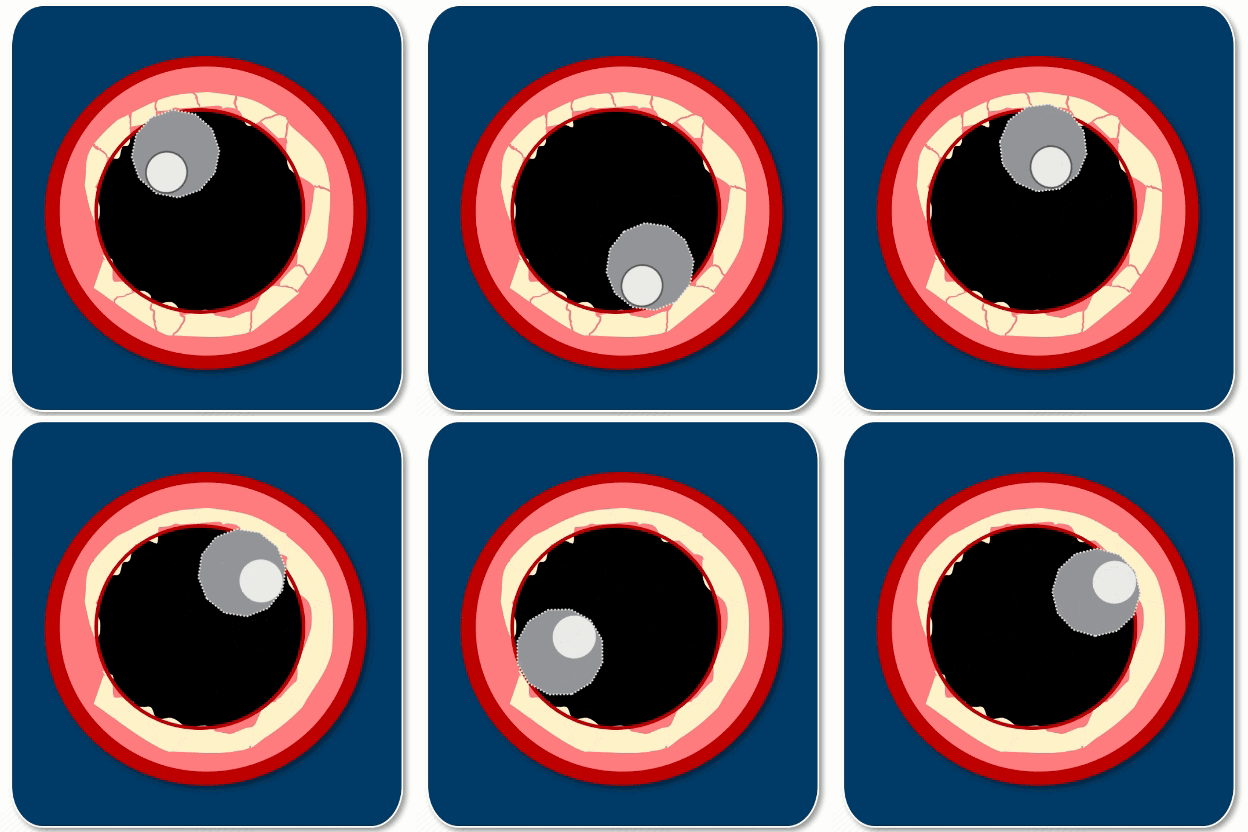

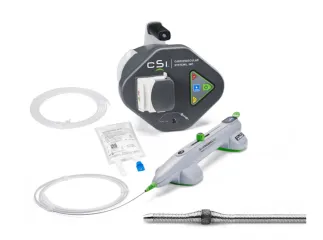
The Diamondback 360 coronary orbital atherectomy system is an innovative technology already approved by the US FDA and in the EU. A 1.25 mm diamond-coated eccentric burr orbits at high speed around a dedicated guidewire; the centrifugal force keeps the diamond-coated burr in 360° contact with the vessel wall, treating protruding surface stenosis, while high-frequency centrifugal oscillation loosens deep calcium and allows the vessel to expand. The technology effectively handles complex lesions such as severe calcification, significantly raises the success rate of complex procedures, and is indicated for patients with primary severe coronary calcification eligible for percutaneous intervention — greatly improving patient outcomes.
"HK-Macao Drug & Equipment Connect" Accelerates the Arrival of Innovative Drugs and Devices in Mainland China
In February 2023, Foshan Chancheng Hospital became one of the first designated medical institutions for the "HK-Macao Drug & Equipment Connect" in Foshan. It has since successfully introduced multiple international innovative drugs and devices covering oncology targeted therapy, cardiovascular intervention, orthopedic joint regeneration, cochlear implants and other high-demand areas — serving nearly 900 patient visits to date.
Liang Shuzhen, Vice President of Foshan Chancheng Hospital, said: "Our hospital has always provided patients with a high-quality medical experience to international standards. The successful first application of coronary orbital atherectomy marks a breakthrough in our treatment of complex coronary heart disease. Going forward, we look to deepen the practice of 'HK-Macao Drug & Equipment Connect' and build Foshan Chancheng Hospital into a hub of international medical resources in the Greater Bay Area, so that more patients can enjoy high-quality medical services aligned with international standards without leaving home."
Care for Complex Coronary Disease at Foshan Chancheng Hospital
- Heart Hospital carrying out TAVR, MitraClip and advanced coronary intervention
- First designated "HK-Macao Drug & Equipment Connect" institution in Foshan — nearly 900 patient visits served with international innovative drugs and devices
- International Medical Center (FIMC) serving patients from 100+ countries since 2019